The Must-Know SAT Math Formulas & Rules

While many problems can now be solved efficiently using Desmos on the digital SAT, students who understand the underlying concepts are often able to recognize patterns more quickly and approach questions with greater confidence.
In this guide, we will review some of the most important SAT Math formulas and rules that every student should know before test day.
Linear Equations
1) Slope Formula
m = (y₂ - y₁) / (x₂ - x₁)
2) Slope-Intercept Form of a Line
y = mx + b
m = slope
b = y-intercept
x & y = distinct points on the graph
Slope formula & Slope-intercept form are two of the most common line equations tested on the SAT. Students should be able to quickly identify the slope and y-intercept, convert other forms of linear equations into slope-intercept form, and understand how changes to m and b affect the graph.
Quadratics
3) Vertex Form of a Parabola or a Quadratic
y = a(x - h)² + k
a = determines the direction and width of the parabola; a constant in front of x² of standard form.
a > 0 → opens upward
a < 0 → opens downward
larger |a| → narrower parabola
smaller |a| → wider parabola
Example:
y = 2(x − 3)² + 5
Vertex: (3, 5)
Opens upward
Narrower than y = x²
Many SAT questions test the ability to recognize the vertex, determine the maximum or minimum value of a quadratic function, and understand how changes to a, h, and k affect the graph.
4) Discriminant
Δ = b² - 4ac
Positive Δ - there are 2 distinct real roots. The graph will cross the x-axis at 2 different places.
Negative Δ - There are 2 complex roots. The graph does not cross or touch the x-axis anywhere
0 Δ - 1 real root. Graph touches the x-axis at exactly 1 point
One of the most overlooked “formula” in the SAT. Discriminant form can help us to figure out the type of solution for a parabola.
5) Standard Form
y = ax² + bx + c
Many SAT questions provide quadratics in standard form and ask students to identify key features of the graph. When possible, look for opportunities to factor the expression to find the x-intercepts. Students should also recognize that the coefficient a determines whether the parabola opens upward or downward, while c represents the y-intercept.
6) Quadratic Formula
x = (-b ± √(b² - 4ac)) / (2a)
Thanks to Desmos, students can often find the x-values of a quadratic function without using the Quadratic Formula. While it is not essential for every SAT question, knowing the formula can be helpful if you have difficulty using Desmos.
Exponential Growth and Decay
7) Exponential Growth
y=a(1+r)^t
Where:
a = initial value
r = growth rate (decimal)
t = time
Example:
y=500(1.05)^t
The quantity increases by 5% each time period.
8) Exponential Decay
y=a(1−r)^t
Where:
a = initial value
r = decay rate (decimal)
t = time
Example:
y=500(0.90)^t
The quantity decreases by 10% each time period.
Many SAT questions do not directly ask for the growth or decay rate. Instead, students are often given an equation and asked to interpret what it means in context. When solving exponential growth and decay problems on the SAT, always identify the multiplier (the number inside the parentheses) first and then determine how much it differs from 1. This simple step can help avoid some of the most common mistakes on exponential function questions.
9) Exponent Rules
Product Rule (Same Base)
aᵐ × aⁿ = aᵐ⁺ⁿ
Quotient Rule (Same Base)
aᵐ ÷ aⁿ = aᵐ⁻ⁿ
Power of a Power Rule
(aᵐ)ⁿ = aᵐⁿ
Power of a Product Rule
(ab)ⁿ = aⁿbⁿ
Power of a Quotient Rule
(a/b)ⁿ = aⁿ/bⁿ
Zero Exponent Rule
a⁰ = 1
Negative Exponent Rule
a⁻ⁿ = 1/aⁿ
Fractional Exponent Rule
a¹⁄ⁿ = ⁿ√a
Fractional Exponent Rule (General Form)
aᵐ⁄ⁿ = ⁿ√(aᵐ)
Knowing exponent rules can help you avoid common mistakes and navigate tricky SAT questions.
Geometry
10) Equation of Circle
(x - h)² + (y - k)² = r²
(h,k) - center points of the circle
r - radius
(x, y) points on the circle
Many SAT questions test whether students can identify the center and radius directly from the equation. Be careful with signs inside the parentheses—a common mistake is forgetting that the signs are opposite of the center coordinates.
11) The Pythagorean Theorem
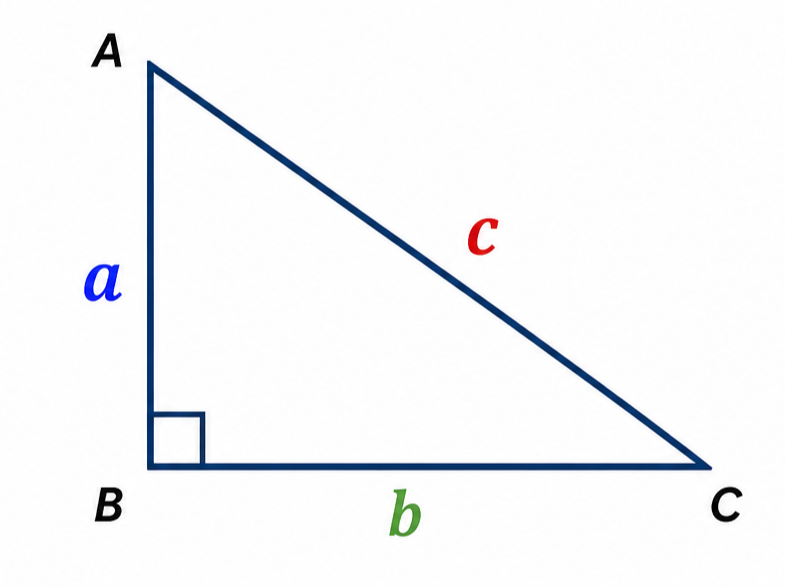
a²+ b² = c²
a = length of one leg
b = length of the other leg
c = length of the hypotenuse (the longest side)
The Pythagorean Theorem applies only to right triangles and is one of the most frequently tested geometry concepts on the SAT. Students commonly use it to find missing side lengths, determine distances, and solve coordinate geometry problems.
12) Special Right Triangles
These show up surprisingly often:
30-60-90 Triangle
x, x√3, 2x
45-45-90 Triangle
x, x, x√2
Special right triangles appear frequently on SAT geometry questions and can often save significant time. Instead of using the Pythagorean Theorem, students can use these side ratios to find missing side lengths quickly. Recognizing a 45-45-90 or 30-60-90 triangle immediately can turn a multi-step problem into a one-step calculation.
13) Percent Change
(New - Original) / Original × 100%
Percent change questions are common on the SAT and often appear in real-world contexts such as prices, populations, test scores, and data tables. One of the most common mistakes is dividing by the new value instead of the original value. Always remember that percent change is based on the original amount, not the final amount.
For example, if a quantity increases from 80 to 100:
((100 - 80) / 80) × 100% = 25%
Many students incorrectly calculate 20% because they divide by 100 instead of 80. Pay close attention to which value represents the original quantity.
Final Thoughts
Knowing the formulas is only the first step. Success on the SAT Math section comes from recognizing patterns, understanding when to apply specific concepts, and developing efficient problem-solving habits under time pressure. As you continue your preparation, focus on applying these formulas strategically rather than simply memorizing them.
Ace the SAT Math Module.
Learn more about individualized SAT and PSAT programs or schedule a consultation to discuss SAT or PSAT goals.
About the Author
Kim is the founder and lead instructor of MetaPrep. A University of Virginia graduate with over 10 years of instruction experience, she specializes in Digital SAT and PSAT preparation, focusing on strategic problem-solving, pattern recognition, and individualized student support.
