
Must-Know SAT/PSAT Grammar Topic #1: Subject-Verb Agreement

Subject-verb agreement is one of the most commonly tested grammar concepts on the SAT & PSAT. While the basic rule sounds simple—singular subjects take singular verbs, and plural subjects take plural verbs—the SAT rarely tests it in straightforward sentences.
Instead, the College Board often hides the true subject inside long phrases, places distracting nouns next to the verb, or uses sentence structures designed to make students choose the wrong verb.
The good news is that once you know the common patterns, these questions become much easier to recognize.
In this guide, we'll cover the subject-verb agreement rules that appear most often on the SAT, along with the traps the College Board frequently uses to test them.
How Do You Know It's a Subject-Verb Agreement Question?
If the answer choices differ only in whether the verb is singular or plural (for example, is/are, has/have, or runs/run), you're most likely looking at a subject-verb agreement question. Your job is to identify the true subject—not the closest noun.
For example:
A. is
B. are
C. was
D. wereor
A. has
B. haveor
A. runs
B. run
4 steps to avoiding mistakes:
Find the verb.
Ask yourself: Who or what is performing this action?
Cross out everything that is not the subject.
Match the verb to the real subject—not the closest noun.
Easy Rule #1 (you probably already know): The Verb Must Match the Subject
Correct: The student is studying.
Correct: The students are studying.
| Singular | Plural |
| student is | students are |
| dog runs | dogs run |
| teacher has | teachers have |
Rule #2: Ignore Prepositional Phrases
The most common SAT trick.
Everything inside a prepositional phrase is NOT the subject.
Incorrect: The collection of books are valuable.
Correct: The collection of books is valuable.
Incorrect: The teacher with the green shoes live nearby.
Correct: The teacher with the green shoes lives nearby.
Subject: teacher
Ignore: with the green shoes
Rule #3: Ignore Interrupting Phrases
SAT loves placing extra information between the subject and verb.
Examples include:
along with
together with
as well as
including
accompanied by
in addition to
rather than
These do NOT make the subject plural.
Example
Incorrect: The principal, along with several teachers, are attending.
Correct: The principal, along with several teachers, is attending.
Subject: principal
Incorrect: Sarah, as well as her friends, were invited.
Correct: Sarah, as well as her friends, was invited.
Rule #4: Compound Subjects
Usually plural.
✅ Tom and Jerry are
✅ Reading and writing require practice.
Exception
When the two nouns refer to one thing or one unit, use a singular verb.
✅ Peanut butter and jelly is my favorite lunch.
“Peanut butter and jelly” = one thing
✅ Macaroni and cheese is delicious.
“Macaroni and cheese” = one thing
Rule #5: Either...Or / Neither...Nor
The verb agrees with the subject closest to it.
Examples
Either the students or the teacher is speaking.
Either the teacher or the students are speaking.
Neither the dogs nor the cat is hungry.
Neither the cat nor the dogs are hungry.
Tip!
Always look at the noun immediately before the verb.
Rule #6: Indefinite Pronoun- Always Singular.
What is an indefinite pronoun?
each
every
everyone
everybody
everything
anyone
anybody
anything
someone
somebody
something
no one
nobody
neither
either
one
Example
Each of the students is prepared.
Everyone has arrived.
Neither of the answers is correct.
What is a relative clause?
Rule #7: Collective Nouns
team
committee
audience
family
class
group
jury
staff
On the SAT, treat these as singular unless the sentence clearly emphasizes individual members acting separately.
Examples
The team is winning.
The committee meets every Friday.
The audience was silent.
Rule #8: Here and There Sentences
The subject comes after the verb.
Examples
There are three cookies.
There is a problem.
Here comes the bus.
Do not assume "there" is the subject. Always look after the verb to find the true subject, then match the verb to that noun.
Rule #9: Titles, Subjects, and Measurements
Even if they contain plural words, they can be singular.
Examples
The Chronicles of Narniais a classic.
Mathematics is difficult.
Five dollars is enough.
Ten miles is too far.
Rule #10: Plural-Looking Singular Nouns
Some nouns end in -s but are singular.
Examples
news
physics
economics
politics
mathematics
Examples
The news is surprising.
Physics is fascinating.
Economics has changed dramatically.
Rule #11: Don't Be Fooled by Relative Clauses
What is a relative clause?
A relative clause is a clause that describes or gives more information about a noun. It usually begins with a relative pronoun:
who (people)
whom (people, object)
whose (possession)
which (things)
that (people or things, usually in essential clauses)
Don’t be fooled by these!!!
Ignore information beginning with who, which, or that when identifying the subject.
Example
The scientist who discovered the fossil was honored.
Subject: scientist
Ignore: who discovered the fossil
Another example
The cars that were parked outside belong to the guests.
Subject: cars
Ignore: that were parked outside
Final Thoughts
Subject-verb agreement questions on the SAT aren't designed to test whether you know the difference between is and are—they're designed to see whether you can identify the real subject of a sentence.
Whenever you encounter a subject-verb agreement question, ignore the distracting words and focus on the noun that actually controls the verb. Prepositional phrases, interrupting phrases, and relative clauses are all common SAT traps meant to pull your attention away from the true subject.
Once you develop the habit of finding the subject first and matching the verb second, these questions become much more predictable—and much easier to answer consistently.
About the Author
Kim is the founder and lead instructor of MetaPrep. A University of Virginia graduate with over 10 years of instruction experience, she specializes in Digital SAT and PSAT preparation, focusing on strategic problem-solving, pattern recognition, and individualized student support.
The Must-Know SAT Math Formulas & Rules

While many problems can now be solved efficiently using Desmos on the digital SAT, students who understand the underlying concepts are often able to recognize patterns more quickly and approach questions with greater confidence.
In this guide, we will review some of the most important SAT Math formulas and rules that every student should know before test day.
Linear Equations
1) Slope Formula
m = (y₂ - y₁) / (x₂ - x₁)
2) Slope-Intercept Form of a Line
y = mx + b
m = slope
b = y-intercept
x & y = distinct points on the graph
Slope formula & Slope-intercept form are two of the most common line equations tested on the SAT. Students should be able to quickly identify the slope and y-intercept, convert other forms of linear equations into slope-intercept form, and understand how changes to m and b affect the graph.
Quadratics
3) Vertex Form of a Parabola or a Quadratic
y = a(x - h)² + k
a = determines the direction and width of the parabola; a constant in front of x² of standard form.
a > 0 → opens upward
a < 0 → opens downward
larger |a| → narrower parabola
smaller |a| → wider parabola
Example:
y = 2(x − 3)² + 5
Vertex: (3, 5)
Opens upward
Narrower than y = x²
Many SAT questions test the ability to recognize the vertex, determine the maximum or minimum value of a quadratic function, and understand how changes to a, h, and k affect the graph.
4) Discriminant
Δ = b² - 4ac
Positive Δ - there are 2 distinct real roots. The graph will cross the x-axis at 2 different places.
Negative Δ - There are 2 complex roots. The graph does not cross or touch the x-axis anywhere
0 Δ - 1 real root. Graph touches the x-axis at exactly 1 point
One of the most overlooked “formula” in the SAT. Discriminant form can help us to figure out the type of solution for a parabola.
5) Standard Form
y = ax² + bx + c
Many SAT questions provide quadratics in standard form and ask students to identify key features of the graph. When possible, look for opportunities to factor the expression to find the x-intercepts. Students should also recognize that the coefficient a determines whether the parabola opens upward or downward, while c represents the y-intercept.
6) Quadratic Formula
x = (-b ± √(b² - 4ac)) / (2a)
Thanks to Desmos, students can often find the x-values of a quadratic function without using the Quadratic Formula. While it is not essential for every SAT question, knowing the formula can be helpful if you have difficulty using Desmos.
Exponential Growth and Decay
7) Exponential Growth
y=a(1+r)^t
Where:
a = initial value
r = growth rate (decimal)
t = time
Example:
y=500(1.05)^t
The quantity increases by 5% each time period.
8) Exponential Decay
y=a(1−r)^t
Where:
a = initial value
r = decay rate (decimal)
t = time
Example:
y=500(0.90)^t
The quantity decreases by 10% each time period.
Many SAT questions do not directly ask for the growth or decay rate. Instead, students are often given an equation and asked to interpret what it means in context. When solving exponential growth and decay problems on the SAT, always identify the multiplier (the number inside the parentheses) first and then determine how much it differs from 1. This simple step can help avoid some of the most common mistakes on exponential function questions.
9) Exponent Rules
Product Rule (Same Base)
aᵐ × aⁿ = aᵐ⁺ⁿ
Quotient Rule (Same Base)
aᵐ ÷ aⁿ = aᵐ⁻ⁿ
Power of a Power Rule
(aᵐ)ⁿ = aᵐⁿ
Power of a Product Rule
(ab)ⁿ = aⁿbⁿ
Power of a Quotient Rule
(a/b)ⁿ = aⁿ/bⁿ
Zero Exponent Rule
a⁰ = 1
Negative Exponent Rule
a⁻ⁿ = 1/aⁿ
Fractional Exponent Rule
a¹⁄ⁿ = ⁿ√a
Fractional Exponent Rule (General Form)
aᵐ⁄ⁿ = ⁿ√(aᵐ)
Knowing exponent rules can help you avoid common mistakes and navigate tricky SAT questions.
Geometry
10) Equation of Circle
(x - h)² + (y - k)² = r²
(h,k) - center points of the circle
r - radius
(x, y) points on the circle
Many SAT questions test whether students can identify the center and radius directly from the equation. Be careful with signs inside the parentheses—a common mistake is forgetting that the signs are opposite of the center coordinates.
11) The Pythagorean Theorem
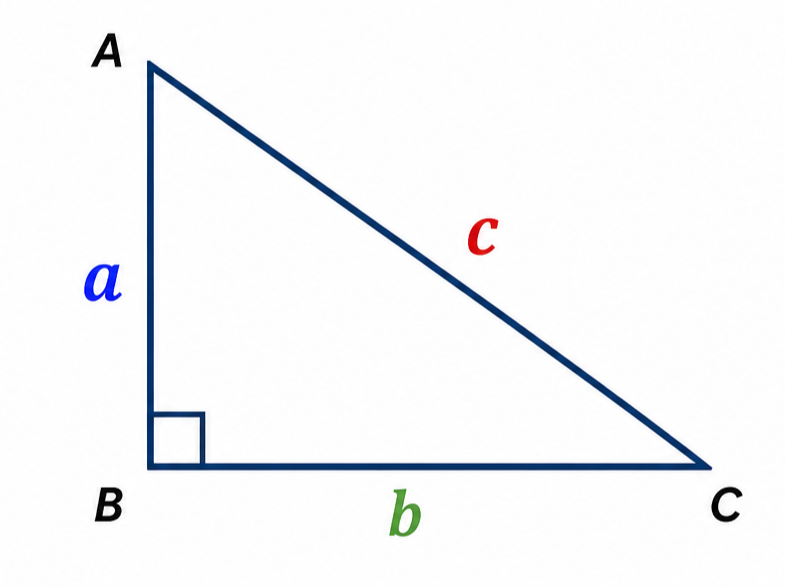
a²+ b² = c²
a = length of one leg
b = length of the other leg
c = length of the hypotenuse (the longest side)
The Pythagorean Theorem applies only to right triangles and is one of the most frequently tested geometry concepts on the SAT. Students commonly use it to find missing side lengths, determine distances, and solve coordinate geometry problems.
12) Special Right Triangles
These show up surprisingly often:
30-60-90 Triangle
x, x√3, 2x
45-45-90 Triangle
x, x, x√2
Special right triangles appear frequently on SAT geometry questions and can often save significant time. Instead of using the Pythagorean Theorem, students can use these side ratios to find missing side lengths quickly. Recognizing a 45-45-90 or 30-60-90 triangle immediately can turn a multi-step problem into a one-step calculation.
13) Percent Change
(New - Original) / Original × 100%
Percent change questions are common on the SAT and often appear in real-world contexts such as prices, populations, test scores, and data tables. One of the most common mistakes is dividing by the new value instead of the original value. Always remember that percent change is based on the original amount, not the final amount.
For example, if a quantity increases from 80 to 100:
((100 - 80) / 80) × 100% = 25%
Many students incorrectly calculate 20% because they divide by 100 instead of 80. Pay close attention to which value represents the original quantity.
Final Thoughts
Knowing the formulas is only the first step. Success on the SAT Math section comes from recognizing patterns, understanding when to apply specific concepts, and developing efficient problem-solving habits under time pressure. As you continue your preparation, focus on applying these formulas strategically rather than simply memorizing them.
Ace the SAT Math Module.
Learn more about individualized SAT and PSAT programs or schedule a consultation to discuss SAT or PSAT goals.
About the Author
Kim is the founder and lead instructor of MetaPrep. A University of Virginia graduate with over 10 years of instruction experience, she specializes in Digital SAT and PSAT preparation, focusing on strategic problem-solving, pattern recognition, and individualized student support.
The Hidden Patterns Behind SAT Reading & Writing Questions
Success on the SAT Reading & Writing section is not simply a matter of reading faster or analyzing text. Many high-scoring students develop the ability to recognize recurring patterns in question design, answer choices, and common traps when preparing for the exam.

The SAT is a “standardized” examination administered to students across the world; the test must maintain a high degree of objectivity and consistency. Every question must have one clearly correct answer that can be justified using evidence and established scoring criteria.
In the Mathematics section, achieving this level of objectivity is relatively straightforward. Mathematical problems are designed around fixed rules and procedures, allowing answers to be verified through calculation. As a result, there is little room for disagreement regarding the correct response.
The SAT, however, operates under a different set of requirements. As a standardized examination administered to millions of students, every Reading & Writing question must have one clearly defensible answer. College Board cannot rely on subjective interpretation when scoring an exam at such a large scale. Questions must therefore be designed in a way that allows one answer choice to be objectively supported by the text, while the remaining choices contain identifiable flaws.
This requirement for objectivity creates patterns throughout the exam. Although passages change from test to test, the logic behind correct answers and common distractors remains remarkably consistent. Students who recognize these recurring patterns are often able to navigate Reading & Writing questions more efficiently than those who rely solely on reading ability or intuition.
The Power of Pattern Recognition
Because the exam is standardized, College Board cannot create an unlimited number of question structures. Every question must assess a specific skill, contain one objectively correct answer, and remain fair for all test takers. As a result, similar patterns naturally emerge across different exams.
For example, a Function Question may ask about a sentence in a science passage on one test and a historical passage on another. Although the topics are different, the underlying skill being assessed remains the same.
This is why high-scoring students often focus less on the topic of the passage and more on the underlying pattern of the question. Rather than viewing each question as entirely new, they learn to recognize familiar structures that appear repeatedly throughout the exam.
Reading Question Patterns
In the SAT/PSAT Reading & Writing module, the same question patterns appear repeatedly across different exams. While the passages themselves may change, the underlying question types often remain the same.
Some common examples include:
Textual Evidence Questions
Function Questions
Weaken the Claim Questions
One reason pattern recognition is so effective is that many question types are accompanied by recurring trigger phrases that signal what the test is asking students to do.
For example:
Textual Evidence Questions
Often signaled by phrases such as "Based on the text" or "According to the text."
Function Questions
Often ask students to determine the purpose or role of a particular sentence, detail, or line within the passage; “function of the underlined text”.
Weaken the Claim Questions
Often ask which finding, piece of evidence; “weaken the statement”.
By learning to recognize these trigger phrases, students can often identify the underlying question type before they even begin evaluating the answer choices. This allows them to approach questions with a clearer strategy and a stronger understanding of what the test is actually assessing.
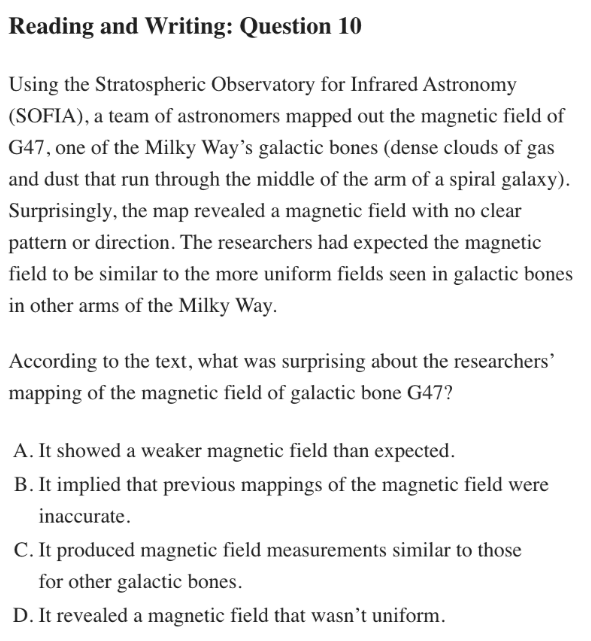
“According to the text” Question from College Board PSAT 8/9 Practice Exam

Another “According to the text” from College Board PSAT 8/9 Practice Exam
Reading Multiple Choice Questions
Interestingly, patterns are not limited to the questions themselves. Similar patterns can often be found in the answer choices.
Many SAT and PSAT Reading & Writing answers begin with recurring phrases that signal a particular function. In Function Questions, for example, students may frequently encounter answer choices beginning with phrases such as:
"To introduce..."
"To explain..."
"To emphasize..."
"To highlight..."
Over time, students begin to recognize how these recurring answer structures correspond to specific textual functions.
As a result, strong test-takers are often able to eliminate incorrect choices more efficiently and identify the most accurate answer with greater confidence. Rather than viewing every answer choice as entirely new, they learn to recognize familiar patterns that appear repeatedly throughout the exam.
The Hidden Traps of SAT Preparation
Many students prepare for the SAT by practicing many questions from variety of sources such as The Princeton Review, Mometrix, Kaplan, etc. However, there is a reason why this type of preparation may not be an effective way to study for the SAT. While resources such as Princeton Review, Kaplan, and Mometrix can provide useful practice, they are ultimately written by companies attempting to imitate College Board's testing style.
Students who spend most of their time studying non-College Board questions may become familiar with the patterns of those publishers rather than the patterns that appear on the actual SAT. For this reason, understanding how College Board designs its questions is often more valuable than simply increasing the number of practice questions completed.
A More Strategic Approach to SAT/PSAT Preparation
Understanding patterns is only the first step. The more important question is how students train themselves to recognize these patterns consistently.
Many students believe that completing a large number of practice questions will automatically lead to higher scores. While practice is certainly important, improvement often depends more on the quality of review than the quantity of questions completed.
The MetaPrep Method: A Systematic Approach to Score Improvement
At MetaPrep, we believe that meaningful score improvement comes from understanding the patterns behind the exam rather than simply memorizing rules or completing endless practice questions.
Our SAT and PSAT programs focus on pattern recognition, strategic analysis, individualized study plans, and structured skill development. Each student receives targeted instruction based on their strengths, weaknesses, and long-term goals.
About the Author
Kim is the founder and lead instructor of MetaPrep. A University of Virginia graduate with over 10 years of instruction experience, she specializes in Digital SAT and PSAT preparation, focusing on strategic problem-solving, pattern recognition, and individualized student support.
Why Desmos Training Is Now a Core Part of SAT Preparation

Desmos is no longer just an optional calculator—it has become an essential part of Digital SAT preparation. In this post, we'll explore how Desmos works on the Digital SAT and share practical tips for using it efficiently on test day.
What Is Desmos?
Desmos is an advanced online graphing calculator that is built directly into the Digital PSAT and SAT testing platform. Unlike a traditional handheld calculator, Desmos allows students to graph equations, create tables, analyze functions, and visualize mathematical relationships in real time.
Because it is integrated into the Bluebook testing application, students can access Desmos throughout the entire Math section without needing any additional software or equipment.
Importance in the Collegeboard Exams
Since the PSAT and SAT transitioned to digital testing in 2023 and 2024, Desmos has become an essential tool for students preparing for College Board exams. Many students spend hours studying content, but receive little instruction on how to use the calculator built directly into the testing platform.
Here is a glimpse of what this math tool looks like in the SAT & PSAT Exams.
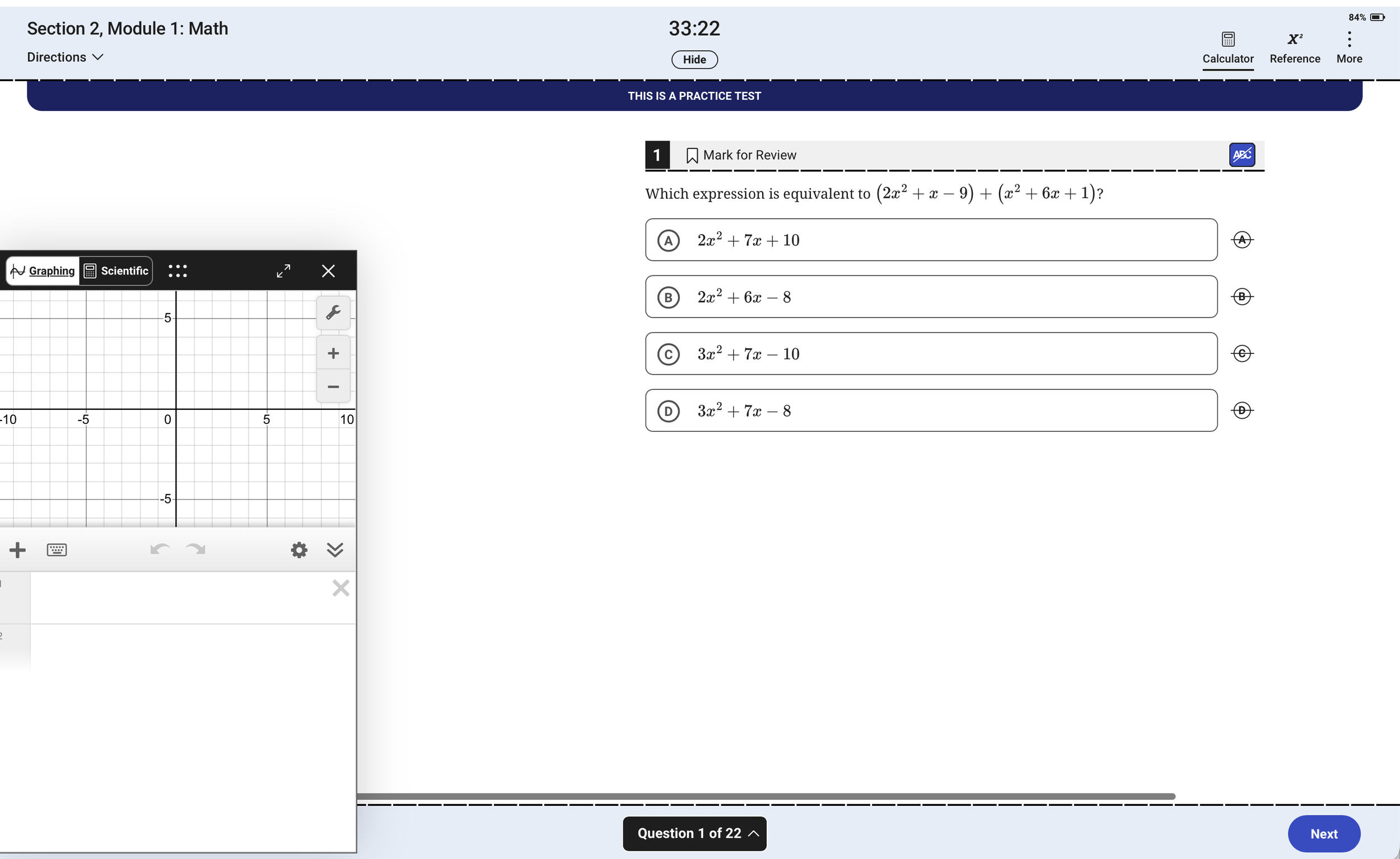
Pop-up box on the left shows Graphing Desmos tool. Bluebook allows student to switch to Scientific & Graphing versions.
Common Uses of Desmos on the SAT
Graphing Functions and Equations
One of the most common uses of Desmos is graphing equations. Instead of solving every problem algebraically, students can often graph a function and analyze its behavior visually. This can be particularly helpful when working with linear equations, quadratics, and exponential functions.
Checking Answers
Even when students solve a problem using traditional methods, Desmos can be used to verify the answer. A quick graph or table can help confirm whether a solution makes sense before moving on to the next question.
Using Tables to Identify Patterns
The table feature allows students to quickly observe relationships between variables. This can be useful for questions involving functions, rates of change, and numerical patterns where visualizing values may be easier than performing lengthy calculations.
Finding X-Intercepts and Y-Intercepts
Many SAT questions involve identifying where a graph crosses the x-axis or y-axis. Desmos can display these points directly, helping students solve certain problems more efficiently.
Understanding Transformations
Students can use Desmos to visualize how graphs change when equations are shifted, stretched, reflected, or compressed. This can make abstract concepts easier to understand and apply on test day.
Comparing Multiple Functions
Desmos makes it easy to graph several functions simultaneously. Students can compare graphs, identify similarities and differences, and analyze how changing parameters affects the shape of a function.
Desmos Features Many Students Don't Know About
Perhaps the biggest misconception is that Desmos is only a calculator. In reality, many high-scoring students use it as a visualization tool, a formula replacement, and in some cases, a time saving tool.
Using Desmos to Find Distance Between Two Points
Traditionally, students learn the Distance Formula:
d = √[(x₂ − x₁)² + (y₂ − y₁)²]
While students should still understand the underlying concept, students can save time by entering two points directly into Desmos.
Type “distance” and in the wide parentheses, type in the two coordinates. Make sure the coordinates are in their own parenthesis and separate with a comma!
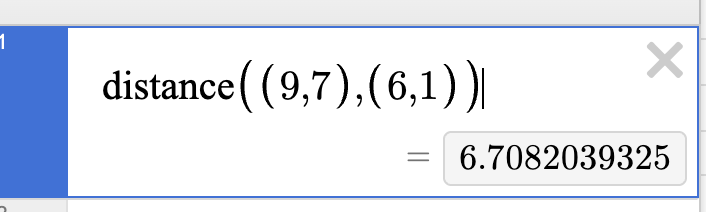
You can simply type “distance” and put your two points with a comma.
Using the Slider Tool
Some SAT questions ask students to understand how changing a number in an equation affects the graph.
The graph y = 5x^2 + 3x - k passes through the point (0.53, 0). What is the value of k?
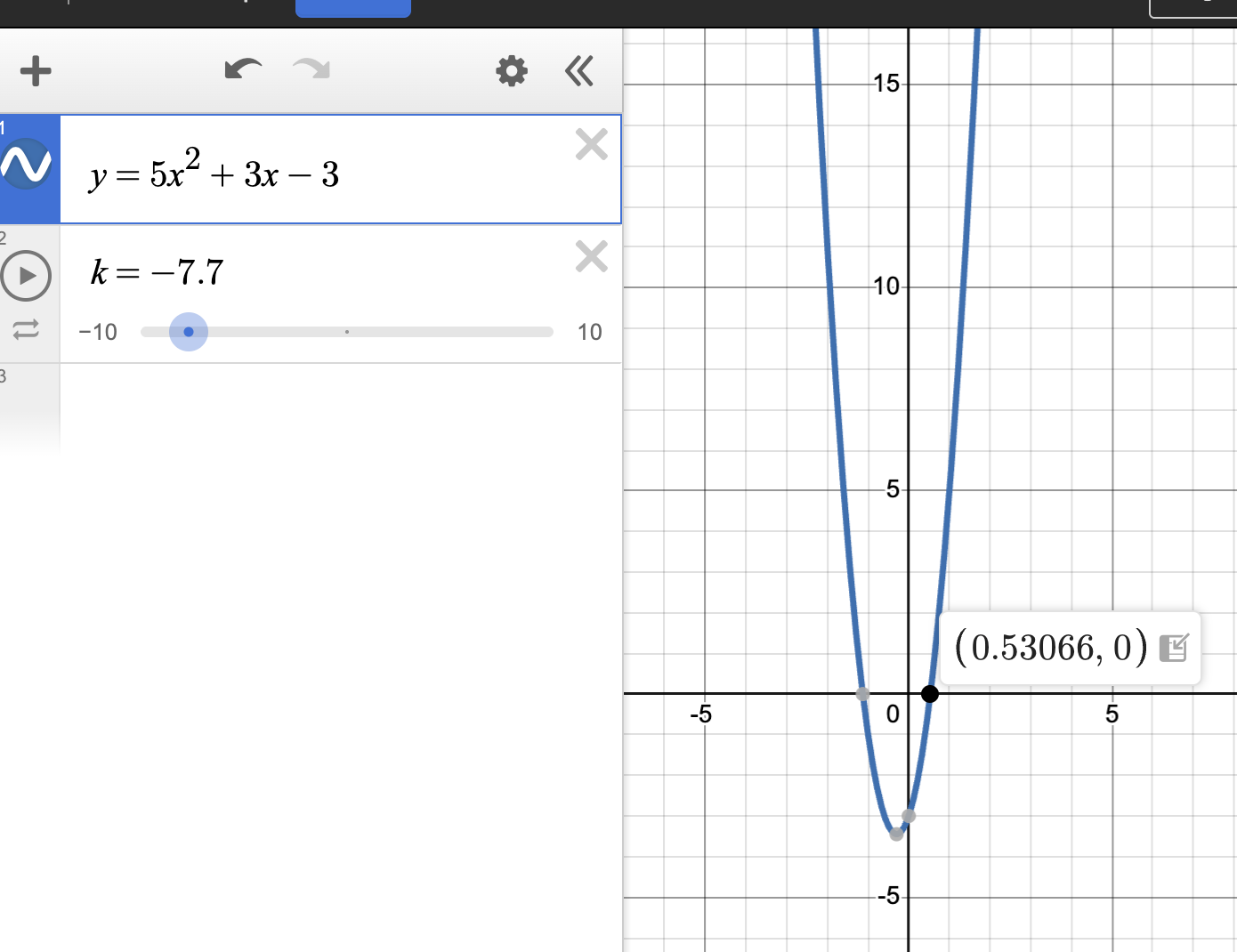
Desmos will create a slider for k. Students can then move the slider until the graph passes through the point (0.53066,0).
Let Desmos Do the Statistics!
Students can find the mean and median without spending time working out the math.
You can type mean() and median(), and insert numbers in any order in the parentheses for Desmos.
Using the Table Feature to Test Values
While many students use Desmos only for graphing, the table feature can be equally useful. It allows students to quickly generate values as well as forming different equations.
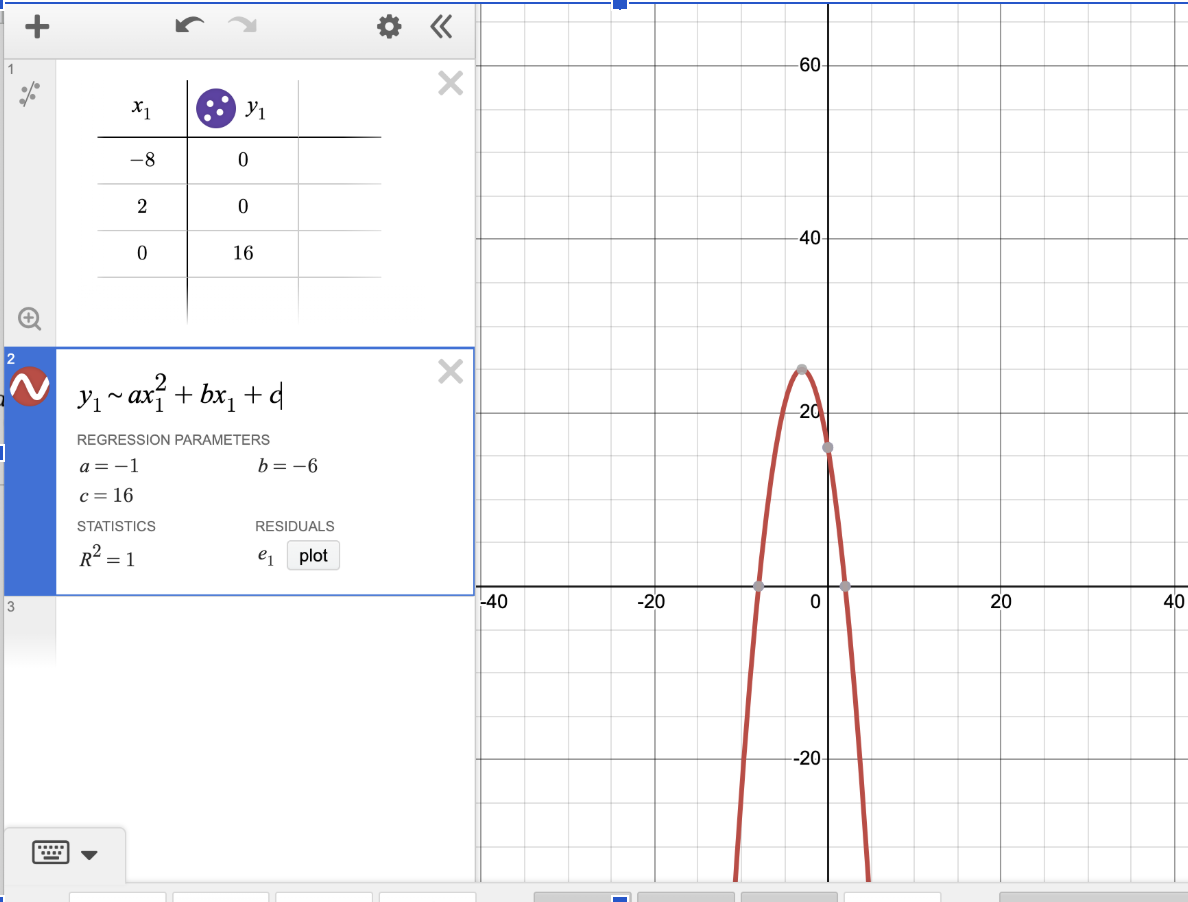
With three or more coordinates, table becomes an extremely useful for forming equations and finding values for parts of an equation.
Final Thoughts
When used strategically, Desmos can help answer exam questions with shortcuts and reduce errors. By combining strong content knowledge with effective Desmos skills, students can approach the Digital PSAT and SAT with greater efficiency and confidence.
Like any test-taking tool, Desmos is most effective when practiced before exam day. The earlier students become familiar with its features, the better prepared they will be to take advantage of them when it matters most.
Interested in SAT or PSAT Preparation?
Learn more about individualized SAT and PSAT programs or schedule a consultation to discuss your student's goals.
About the Author
Kim is the founder and lead instructor of MetaPrep. A University of Virginia graduate with over 10 years of instruction experience, she specializes in Digital SAT and PSAT preparation, focusing on strategic problem-solving, pattern recognition, and individualized student support.